As we move into fall, now is the time to start thinking about winter forages. Honestly, in a year (not like last year-no rain, at all.) with the right grazing management system, winter forages are the key to keeping cattle fed, healthy, and fat during the coldest part of the year in Georgia. Good winter grazing will help stretch hay supplies, provide quality nutrition for cattle, and reduce the amount of purchased feed needed during the winter months.
I hear the comment a lot that hay is expensive enough as it is, why would I pay to plant grazing too? Winter grazing is one of the most nutritious options for Georgia cattle producers during the winter, especially those who are calving during that time. Winter grazing will help keep body condition scores up during peak lactation. Below is a chart created by Dr. Baxter, showcasing how winter forages can be cheaper for your pocketbook than feeding grain or other feedstuffs during the winter.
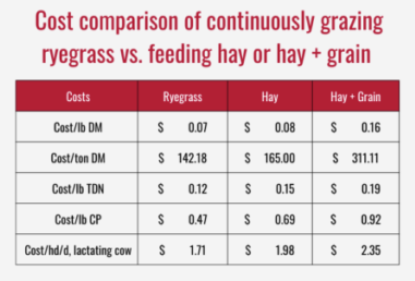
One thing that I would like to point out is that bermuda or bahiagrass hay is often not nutritionally sound enough to feed alone in Georgia. In the event you are feeding hay that doesn’t meet the requirements of your mama cows, you will likely see a loss of body condition. To showcase the importance briefly of body condition in mama cows, the difference between a body condition of a 6 versus a 3 can be a 140 pound difference in weaned calves, and a 93% pregancy rate versus a 43% pregnancy rate.
Fortunately, Georgia producers have lots of winter forage options and mixes, including rye, triticale, oats, wheat, annual ryegrass and clovers, to choose from. Knowing what your end goal is, is critical in deciding what you plan to plant. This chart created by Ross Greene, Evans/ Candler County ANR Agent, along with myself and Dr. Baxter, is a tool in helping you decide what your best mix or forage is based on your end goal.
| Production Goal | Species to Consider | Why |
| Earliest winter grazing | Rye | Earliest maturing; excellent winter hardiness |
| Season-long grazing | Small Grains + Annual Ryegrass | Small grains offer earlier forages, and ryegrass extends production into spring, mixing those can off longer grazing opportunities. |
| More spring small-grain growth | Oats | Later maturity and more spring growth than rye in South/Central Georgia. |
| Baleage or Silage | Small Grains or Annual Ryegrass | High- quality forage when cut at the proper stages. |
| Season Long High Yield | Annual Ryegrass | Anticipated 4-6 tons of dry matter per acre; the most productive winter annual forage. |
| Add legumes and reduce N need | Annual clover + grass | Legumes improve protein quality and can fix nitrogen, reducing nitrogen application needs. |
Seeding rates will also vary by forage and whether it is planted alone or in a mixture. For example, rye, triticale, oats and wheat are generally planted at 90 to 120 pounds per acre when planted alone or 60 to 90 pounds per acre in a mixture. Annual ryegrass is planted at about 25 to 30 pounds per acre alone or 15 to 25 pounds per acre in a mixture.
For Coastal Plain producers, the typical planting window is late September through late October. Planting should coincide with soil moisture. Most small grains should be planted about 1 to 1.5 inches deep, while annual ryegrass and clovers are planted much shallower, generally ¼ to ½ inch deep.
Following the decision of what you’re planting, preparing the land and getting it planted can be different for the species you decided on. As always, we recommend starting with a soil sample and fertilizing or liming your pastures or hay fields according to that sample. Fertilizing winter forages does not have to be complicated, but soil testing should always be the first step.
Soil pH should be around 6.0 so nutrients are available and the forage can develop a good root system.
For rye, wheat, and oats, about 100 pounds of nitrogen per acre during the growing season is recommended, with 50 pounds around establishment and another 50 pounds in late winter.
If ryegrass is included with your small grains, another 50 pounds of nitrogen in early spring can help extend the grazing season.
If annual clovers, such as arrowleaf or crimson clover, are in the forage program then consider applying 30 to 50 pounds nitrogen per acre at planting. The winter annual grasses can possibly shade out and compete with the clover if higher rates of nitrogen are applied at planting. If the winter annual forage stand contains less than 40 to 50% clover, apply 50 pounds nitrogen per acre in late winter or early spring. If you are overseeding clovers without winter annual grasses into summer perennial forages then no nitrogen is recommended. If clovers are being used in the forage program you will need to make sure to use the correct inoculant to start the nitrogen fixation process.
For more information about winter forages and supplementing cattle during the winter season, please contact your local county extension agent.